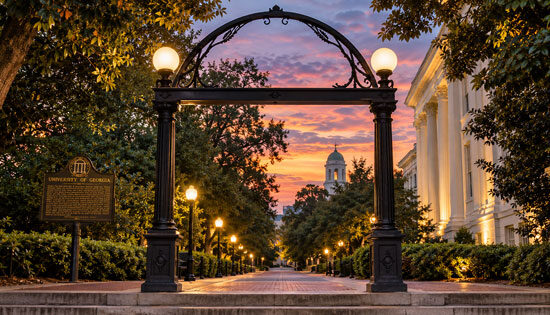
GEORGIA — Savannah’s Victorian District ranked Georgia’s most quintessential neighborhood in a nationwide survey.
Release:
Victorian District (Savannah) Voted the Most “Georgia” Place to Live.
Every state has a look. Some places announce themselves with porches and live oaks; others with bungalows, balconies, mountain views, or coral-pink Mediterranean homes.
To find out which neighborhoods best capture that sense of place, the Justin Havre Real Estate Team surveyed 3,021 respondents, asking them to name the residential area they believe is the most quintessential representation of their state.
In other words: if one neighborhood had to stand in for the whole place, which would it be?
In Georgia, the survey results were as follows:
#1 Victorian District, Savannah
Savannah’s Victorian District captures Georgia’s coastal historic character, with compact streets, painted houses, deep porches and mature live oaks shading the neighborhood. Developed south of the city’s original historic core, the area has the layered look of a Southern port city that expanded over time, with Queen Anne, Italianate, Folk Victorian and other period styles sitting close together. Its residential streets feel unmistakably Georgian: humid, historic, ornate and shaped by shade, preservation and old city planning.
#2 Inman Park, Atlanta
Inman Park reflects Georgia’s urban residential heritage, with Victorian homes, broad porches, curving streets and generous lots set close to downtown Atlanta. Built as one of the city’s earliest planned suburbs, the neighborhood still carries the look of late 19th- and early 20th-century Atlanta, where streetcar-era growth created leafy residential pockets beyond the commercial core. Its mix of restored homes, gardens and walkable streets captures the state’s capital-city side: Southern, urban, historic and increasingly vibrant.
#3 Madison Historic District, Madison
Madison Historic District shows Georgia’s small-town architectural identity, with antebellum homes, Greek Revival mansions, historic churches and shaded streets set within a compact town landscape. The area has a preserved, old-South character, but on a smaller and more intimate scale than Savannah or Atlanta. Its white columns, wide lawns, porches and courthouse-town setting capture a version of Georgia rooted in rural prosperity, preservation and deep regional history.
Across the country, some of the responses leaned heavily on history and architecture, while others pointed to neighborhoods that capture a broader way of life – coastal, leafy, walkable, sun-soaked or unmistakably local.
For Alabamians, the answer was Montgomery’s Garden District, a historic residential area known for its broad streets, mature landscaping and homes dating from the late 19th and early 20th centuries. The neighborhood includes Queen Anne, Classical Revival, Craftsman and other period styles, creating a varied picture of Alabama’s residential past. Its large homes, shaded sidewalks and established gardens give the area a settled, lived-in character closely tied to Montgomery’s role as one of the state’s oldest and most historically significant cities.
Californians, meanwhile, chose Bungalow Heaven in Pasadena as the Golden State’s most quintessential neighborhood. The area reflects one of California’s most recognizable residential styles, with quiet streets lined by early 20th-century Craftsman bungalows. Wide porches, low-pitched roofs, mature trees, and garden lots give the neighborhood a warm, settled Southern California feel. It captures an older vision of the state: sunny, domestic, arts-and-crafts influenced and built around indoor-outdoor living long before California became shorthand for freeways, glass towers and endless sprawl.
In Florida, Coral Gables came out on top. The South Florida city captures one of the state’s most recognizable residential looks, with Mediterranean Revival homes, coral-rock details, arched entries, tiled roofs, and lush tropical landscaping. Designed as a planned city, Coral Gables combines grand residential streets with palms, fountains, and a sense of old Florida elegance. Its architecture reflects the state’s Spanish, Caribbean and subtropical influences, creating a polished Florida look built around shade, gardens and outdoor living.
Ohians named Ohio City as the best representation of the state’s urban character, with historic homes, workers’ cottages, Victorian houses and dense residential blocks close to Cleveland’s industrial and commercial core. The neighborhood reflects the state’s manufacturing-era growth, with brick, wood-frame and modestly ornate homes sitting near markets, churches and old streetcar routes. Its mix of grit, preservation and city living gives it a distinctly Ohio feel – urban, practical, historic and tied to working-class roots.
In Wisconsin, Astor Historic District shows Wisconsin’s older small-city character, with Victorian homes, Craftsman houses, porches and tree-lined streets close to Green Bay’s historic core. The neighborhood reflects the city’s long history as a trading, lumber and industrial center near the bay. Its mix of historic houses, mature landscaping and Great Lakes practicality gives it a distinctly Wisconsin feel – sturdy, established, modestly ornate and rooted in local community.
Beyond the individual neighborhood picks, the survey also found that local identity still matters deeply when people think about where they live.
Nearly half of respondents said architecture plays a major role in shaping their connection to a neighborhood, with 22% saying it is “very” important and 28% saying it matters “quite a lot.”
That attachment to character also showed up when respondents were asked what kind of neighborhood they would rather live in: 46% said they would prefer somewhere strongly local or distinctive.
However, views were almost evenly split on whether newer developments are getting this right. A slight majority (51%) said newer developments in their state reflect the local character well.
When asked what makes newer neighborhoods feel less local, the biggest complaint was sameness.
The top reasons were:
- 32% said homes look too similar.
- 17% pointed to a lack of historic architecture.
- 13% said there are not enough mature trees.
- 13% said there are too many chain stores nearby.
- 9% said newer areas are not walkable enough.
- 6% said building materials feel generic.
- 5% said the landscaping does not match the region.
- 5% pointed to too much car-focused design.
Still, most people remain proud of where they live. Over two-thirds of Georgia respondents, 78%, said they are proud of the residential character of their state.
The survey also suggests that a neighborhood’s sense of place is not created by architecture alone. When respondents were asked what gives a neighborhood the strongest local identity, the most common answer was people and community, chosen by 31%. History followed at 21%, while natural setting came in at 13%.
Other factors included:
- Overall atmosphere: 8%
- Architecture: 7%
- Landscaping: 5%
- Street layout: 5%
- Cultural identity: 4%
- Local businesses nearby: 3%
- Weather or climate: 3%
It also appears that many people would put money behind that preference. When asked whether they would pay more to live in a neighborhood with strong local character, 66% said they would.
“People don’t just connect with a neighborhood because the homes are attractive. They connect with the things that make it feel specific: the trees, the street layout, the age of the buildings, the local businesses, the weather, even the way people use their porches, sidewalks, and front gardens,” says a spokesperson from the Justin Havre Real Estate Team. “What this survey shows is that residents still place a real value on neighborhoods that feel rooted. The places people choose are not generic versions of “nice”. They are neighborhoods with memory, personality, and a clear sense of where they belong.”