Mike Walker, Valdosta Today Opinion Contributor
Recently, I was up to Valdosta from Gainesville, Florida where I live to do a story on Valdosta for the web-magazine Porter Briggs, which is dedicated to the history and culture of the American South. Prior to this visit, I knew Valdosta by repute alone, and mostly for two distinct things: its success in high school football and the overall robust cultural heritage of the Wiregrass Region, of which Valdosta serves as a spiritual core of sorts. Wiregrass folkways are a treasure of the South and contain as varied traditions as cane syrup making to shape-note singing to general daily chores of farming, foresting, and turpentining. These were the traditions which form a cultural backbone of the region, and we are all richer for them.
On my visit, I found Valdosta like many mid-sized Southern cities to have a lot of charm but also to be grappling with the economic challenges of moving from an old economy into new ones. Overall, I found Valdosta to be meeting such challenges in an impressive and innovative manner and I reported such in my Porter Briggs article. Nonetheless, it’s important to consider the role of the physical, the geographical, in understanding how an economy like Valdosta’s has changed and how to wrought the desired change currently—the improvements—we want today for a better way of life. Valdosta, like many cities in Georgia and especially many county seats, was built firstly around a courthouse square and the locus of the railroad in town. Indeed, in Valdosta’s example, the city was crafted out of the spot where the railroad was located: nearby Troupville which had been the county seat didn’t get the rail-line so for the continued fortunes of the economy, everyone more or less moved to where the train-tracks were laid. At the time, it was probably hard to imagine that an age would come where rail transport was less-important. Don’t get me wrong: rail is still vital, and nowhere is such more evident than in southern Georgia, however, rail no longer needs to ship as many goods—especially retail goods—directly to the center of town as it did a century or even half-century ago. For that matter, cars, the interstate, and the internet all have changed how we do business and how we live life, allowing for suburbs, allowing for telecommuting. How does a city’s urban center remain vital today?

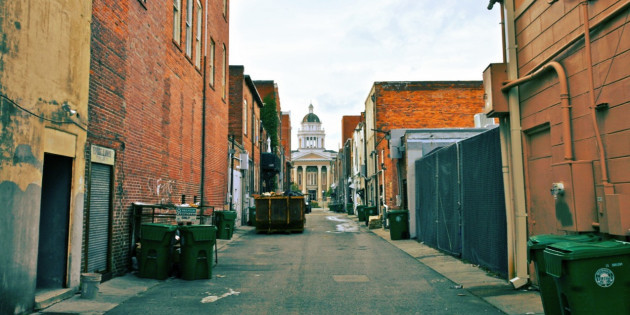
Since much of what I do as a journalist is write about cities and since I’ve written about ones as diverse as San Francisco to Savannah, there were some things very clear to me in Valdosta. For one, the current effort to boost downtown business presence seems not only successful, but fully poised to do exactly what needs to be done. It recognizes the realities, the fact that yes we do a lot of shopping at the mall or online today and that physical offices for many businesses may no longer be downtown. It recognizes a streamlining of the physical needs of business has taken place over the past few decades, but it provides for the fact that restaurants, bars, and other recreation are best when in a walkable and attractive space. It recognizes that Valdosta’s historic 1905 courthouse is one of the finest examples of its type in the South and that historic churches also sprung up around the courthouse square. It provides for alley-ways that could have been dismal spaces being turned into beautiful passages filled with flowers and fountains.
Valdosta also has recognized that a balance is needed in the social provision of culture that brings in from the outside and in contrast, that which provides something new, something home-grown. For the former, the Dosta Playhouse and the good folks at Cinema Downtown bring in plays and films, providing a rich performing arts experience downtown while using historic spaces—including with the Playhouse a vintage 1940s movie theatre. For the latter—the idea of providing something you just can’t get anywhere else—Valdosta has Steel Magnolias, one of the best New Southern restaurants in the nation and one that helped pioneer this movement. Alongside Liam’s of Thomasville, Steel Magnolias has provided the region with truly first-class yet roots-based cuisine. It is a restaurant worth driving hours to dine at, a restaurant that ranks as one of the best in the state. For some, they may think such is nice enough, but what does it really contribute to Valdosta? Its contribution beyond tasty food is that it showcases something you can’t get anywhere else—be that Atlanta, or New York or London. Valdosta and all cities in the South need a landmark restaurant like this, a restaurant not only with fine cuisine but with origins in the very farming fields surrounding the community.
Likewise, the stellar reputation of local sports—especially in football—at the high school level is a draw for Valdosta, a destination-worthy reason to come to the city. Valdosta State University, with a campus as modern and beautiful as most any I’ve ever seen and students as excited yet polite as a preacher at a summer camp meeting is also obviously a huge benefit to the whole local Lowndes community. Tourism has increasingly become a boon to rural cities like Valdosta: I’ve written about how Citrus County, Florida has seen tourism and its natural wonders serve as the primary key to an improved economy and tourism is the basis of Mount Dora, Florida and the fact that small city is actually quite affluent now despite having little in the way of traditional industry. And having nice restaurants and cultural offerings also is key to attracting other forms of industry and businesses: Valdosta’s ample vacant office space downtown—including buildings that have yet to be renovated at all—could be ideal for a mid-sized firm that requires mostly offices and not extensive physical space such as warehouses.
The revival has begun and the necessary toolkit for rebuilding downtown is there. Over the 1950s to 1970s, a lot of people moved into the suburbs and over the 1970s to 1990s the influx of big-box stores, malls, and clustering of retail and restaurants around the interstate changed how people shopped—that’s not a Valdosta thing, nor a Southern thing, it’s an American reality. But downtowns are still the soul of a city—what make a city more than just a clump of houses or criss-cross of streets. Valdosta, I was very happy to note as a visitor, is doing what needs to be done to go forward but via building on its past heritage.
Mike Walker is a journalist who mainly writes about sports and urban issues. He has been published in Porter Briggs, Slate, The Moscow Times, The San Francisco Chronicle, The Bold Italic, The Tottenville Review and elsewhere and contributed to print and broadcast journalism for the nations of Serbia and Croatia.