By Jonathan Frazier
Back in 2011, the movie Dolphin Tale brought attention to the miraculous story of Winter, a dolphin who lost her tail end when a crab trap cut off blood flow. As the story goes, love, hope, and a prosthetic replacement gave Winter a chance to swim again at the Clearwater Marine Aquarium. However, many fail to realized that this is not an isolated/ultra-rare occurrence. There are a number of wildlife creatures that benefit from kind scientists with prosthetic technologies. This article discusses five.
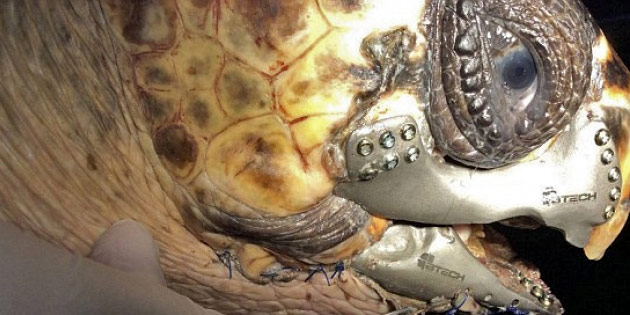
Knowing he wouldn’t be able to fend for himself without the use of his jaw, the rescue team partnered with BTech Innovation. Together, they were able to develop a 3D jaw for this tenacious turtle.
Akut-3, a loggerhead turtle, lost about half his jaw in an incident at sea in May of 2015. After multiple detailed scans by Pamukkale University in Denizli, Turkey, Turkish company BTech Innovation used medical grade titanium to fashion the new beak pieces.
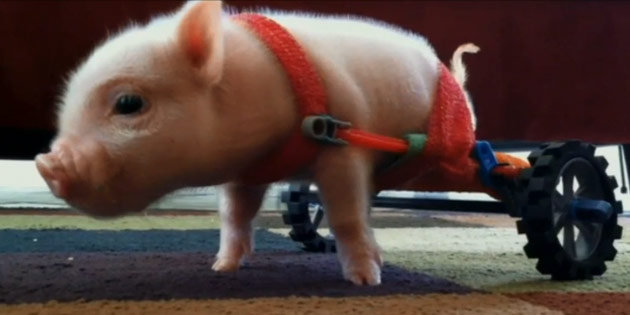
The porcine pet Chris P. Bacon has since graduated to a wheelchair originally built for dogs, having outgrown his first homemade device.
Chris P. Bacon the pig was born with nonfunctional hind legs (fused at the joints), and he was transported Dr. Len Lucero’s clinic in Tampa, Florida to be euthanized. Instead, Dr. Lucero built Chris P. Bacon a set of prosthetic out of his son’s old toys. His adult wheelchair was originally designed for dogs, but gets the job done for Chris. Chris P. and Dr. Lucero remained friends ever since.
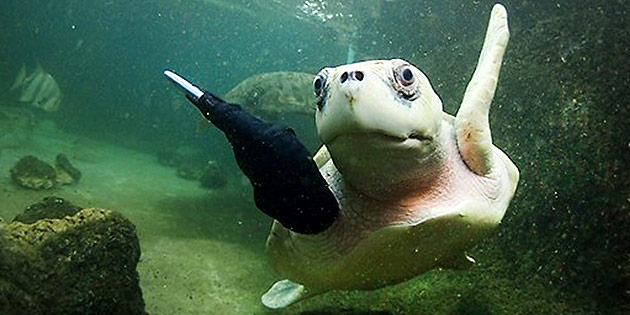
This is Lola, a Kemp’s ridley sea turtle that was found on the beach in Port Aransas, missing part of one flipper, in 2003.
Lola the sea turtle was discovered without part of her front left flipper. Students from the Worchester Polytechnic Institute helped in the creation of a hydrodynamic biomimetic flipper. She was found in 2003 on Port Aransas. It took thirteen years for her prosthetic to be completed!
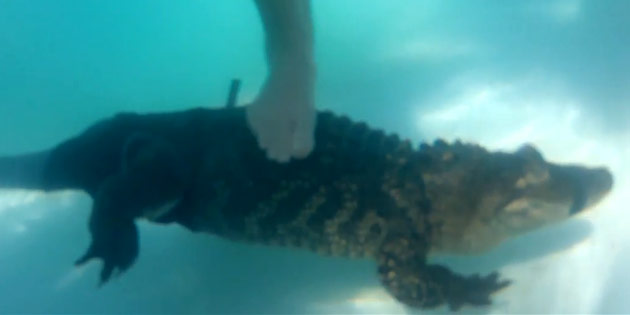
It was a team effort by Phoenix’s Core Institute and Midwestern University professor Justin Georgi to design a replacement rubber tail for Mr. Stubbs.
Mr. Stubbs is an alligator whose tail was likely bitten off by a larger alligator. Professor Justin Georgi at Midwestern University partnered with Core Institute to design a rubber replacement from wet-suit material. As demonstrated in the above image, applying light pressure on his back encourages Mr. Stubbs to propel himself upward with his synthetic tail.
Victoria the goose is suspected to have either been beaten, or her beak was severely bitten by a dog. In either case, Victoria was in desperate need of a replacement beak and loosing weight fast. The final beak was designed by the joint efforts of Cicero Moraes (a 3D designer from Brazil), a team of wildlife workers, and various surgeons. Since the installation of the beak, she has been with the primary rescuer.