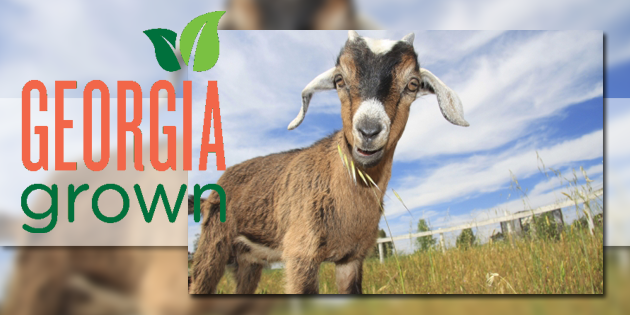
DALTON – Five years ago Fernando Mendez decided to try his hand at raising goats. The proprietor of a 900-acre spread in Arabi named Marview Farms, Mendez raises grassfed livestock – cattle, goats, sheep and hogs – for meat.
“Goats are challenging,” said Mendez, a Cuban émigré who came to America at age six with his family and retired at 47 to a life of organic farming.
He’s learned that goats are smart but mischievous.
“I have a field planted in oats and rye and (this morning ) they were in there. They’ve got plenty of places to be in but they decided to go where they’re not supposed to go,” Mendez said.
Fortunately, they’re easily corrected.
“They know when they’re doing wrong,” he said, so it’s not too hard to get them back on the right path.
Establishing a herd takes commitment and hard work, however. They have to be acclimated to feed and soils, checked and bred for resistance to parasites like the barber pole worm that causes anemia in sheep and goats, and culled for ease of care. While the work is ongoing, Mendez has a herd of about 250 now, and a solid market for his product.
“Everything that I produce is sold,” he said. “There’s no problem of moving goats.”
According to the University of Georgia’s College of Agricultural and Environmental Sciences, the demand for goat meat is high. Growing Chicano and Latino populations in the Southeast and in Texas have brought with them a historical preference for goat meat, also known as chevon. And this cultural preference has turned into big business for those producers who can meet this steadily increasing demand for goat products.
The demand from consumers has led to rising interest among potential producers, said Brenda Jackson, agriculture and natural resources agent in UGA’s Whitfield County Extension Office.
“I have had an increase in requests for info on raising goats and so have several other county agents in the area that I’ve spoken to,” Jackson said.
As a result, Jackson is hosting a series of four Master Goat Farmer Certification Training classes in Dalton to address a number of topics related to managing and producing meat goats. The series will cover nutrition, goat selection, foot trimming, reproduction and kidding, health and diseases, FAMACHA training, business and marketing.
“We want this class to provide new producers the best possible chance for success in starting out as well as provide experienced producers some new ideas they may not have tried yet,” Jackson said.
Classes will be held from 6 p.m. to 9 p.m. Jan. 28, Feb. 4, Feb. 11 and Feb. 18 at the North Georgia Agriculture Fair in Dalton. Meals, refreshments, study materials, manuals, door prizes and graduation certificates are included in the $100 cost of the series.
Registration is limited to the first 75, and must be completed by Jan. 21. Contact the Whitefield County Extension Office at 706.278.8207. Click here for more information.
Did you know …
Goats were among the first animals domesticated by humans.
Georgia has the fourth-largest goat population east of the Mississippi River.
Goats were first brought to America by Christopher Columbus in 1493.
By Amy H. Carter
Market Bulletin Editor
Georgia Grown