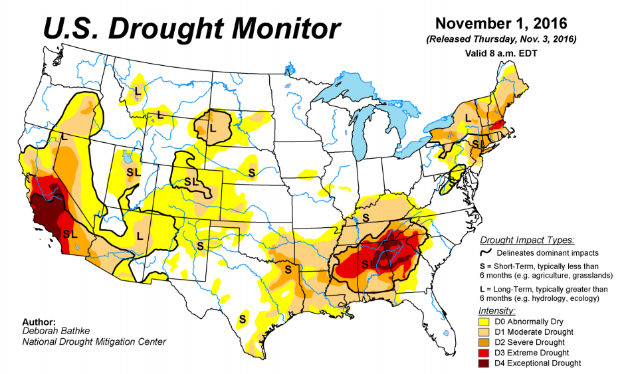
ALANTA – Officials with United States Department of Agriculture said drought conditions have increased to 26.8 percent of the country, including “very poor to poor conditions” and “exceptional drought” areas in Georgia
The increases in drought coverage have been driven by rapidly worsening conditions in the Southeast. Measurable rain has not fallen in parts of Alabama and Mississippi since mid-September, accompanied by chronically and unusually high temperatures.
By October 30, USDA/NASS rated at least one-half of the pastures in very poor to poor condition in Tennessee (65 percent), Georgia (63 percent), and Alabama (52 percent).
USDA/NASS also indicated that topsoil moisture was at least three-quarters very short to short in Mississippi (83 percent), Georgia (80 percent), Louisiana (79 percent), Tennessee (78 percent), and Alabama (76 percent).
Due to dryness, winter wheat planting is substantially behind schedule in several southeastern states, including Alabama (15 percent planted on October 30 vs. the 5-year average of 30 percent) and Louisiana (9 percent planted vs. 27 percent).
Exceptional drought (D4) has developed across parts of the Southeast in recent weeks and currently covers 15 percent of Alabama, 14 percent of Georgia, and 5 percent of Tennessee. Extreme drought (D3) or worse is affecting 52 percent of Alabama and just under 50 percent of Georgia.
In northern Georgia, the surface elevation of Lake Lanier dipped to 1,062.3 feet in early November, 8.7 feet below full pool and 6.7 feet below a year ago. Lake Lanier’s lowest level on record occurred in December 2007, when the surface elevation dipped to 1050.8 feet.
Read more.